
Notes & signals from the network.
Field notes from the engineers moving utilities onto the Utility Network — plus the industry shifts, standards, and trends shaping where utility GIS is heading.

What Esri UC 2026 signals about AI in utility GIS
Esri's User Conference lands July 13–17 in San Diego, and the plenary is framed explicitly around ArcGIS enhanced with AI to automate workflows. For utility GIS teams, that one phrase is a signal worth reading before you're standing in the hall. Here's what the framing tells you about where the platform is heading — and the question it quietly hands back to you.
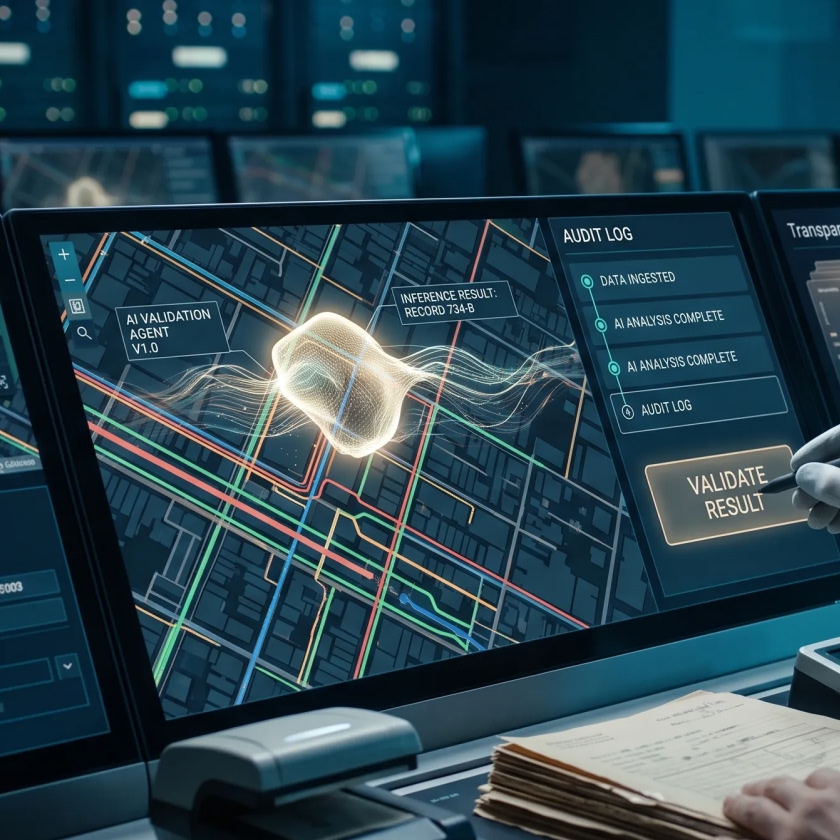
Trust, but validate: putting AI agents near regulated utility records
Esri just shipped a Trusted AI tab and transparency cards to the ArcGIS Trust Center — and still tells you to validate every AI result before you decide. That tension isn't a bug. It's the whole job. Here's how agent work near regulated records stays human-checked and audit-ready by design.

Migration ends. The bad edits don't.
Everyone sells the cutover. The industry quietly admits the truth: projects stumble after go-live, when editors start touching a live network and bad edits silently corrupt connectivity. That's not a migration problem — it's a forever problem. And it's the strongest AI argument for a durable business: always-on agents that validate the network continuously, catching bad edits before they break it.

What a utility data agent actually does all day
"AI agent" sounds like a black box that either saves you or replaces you. Neither is what happens. Here's the unglamorous, minute-by-minute reality of one agent working a live network model — watching edits land, catching the one that breaks connectivity, and handing a reviewer a fix they can approve in thirty seconds.

Dirty data is the real deadline
Every AI migration demo maps a clean schema in ninety seconds. Real migrations don't die on schema — they die on data quality, the months of analyst cleanup the demo never shows. "Agentic data quality" is having a moment for exactly that reason. Here's the reframe: AI isn't a mapping toy, it's the thing that compresses that cleanup from months into days.